
The Statement On The Right to Join a Union Has Finally Arrived
17 November 2026 · By Oliver Tasker
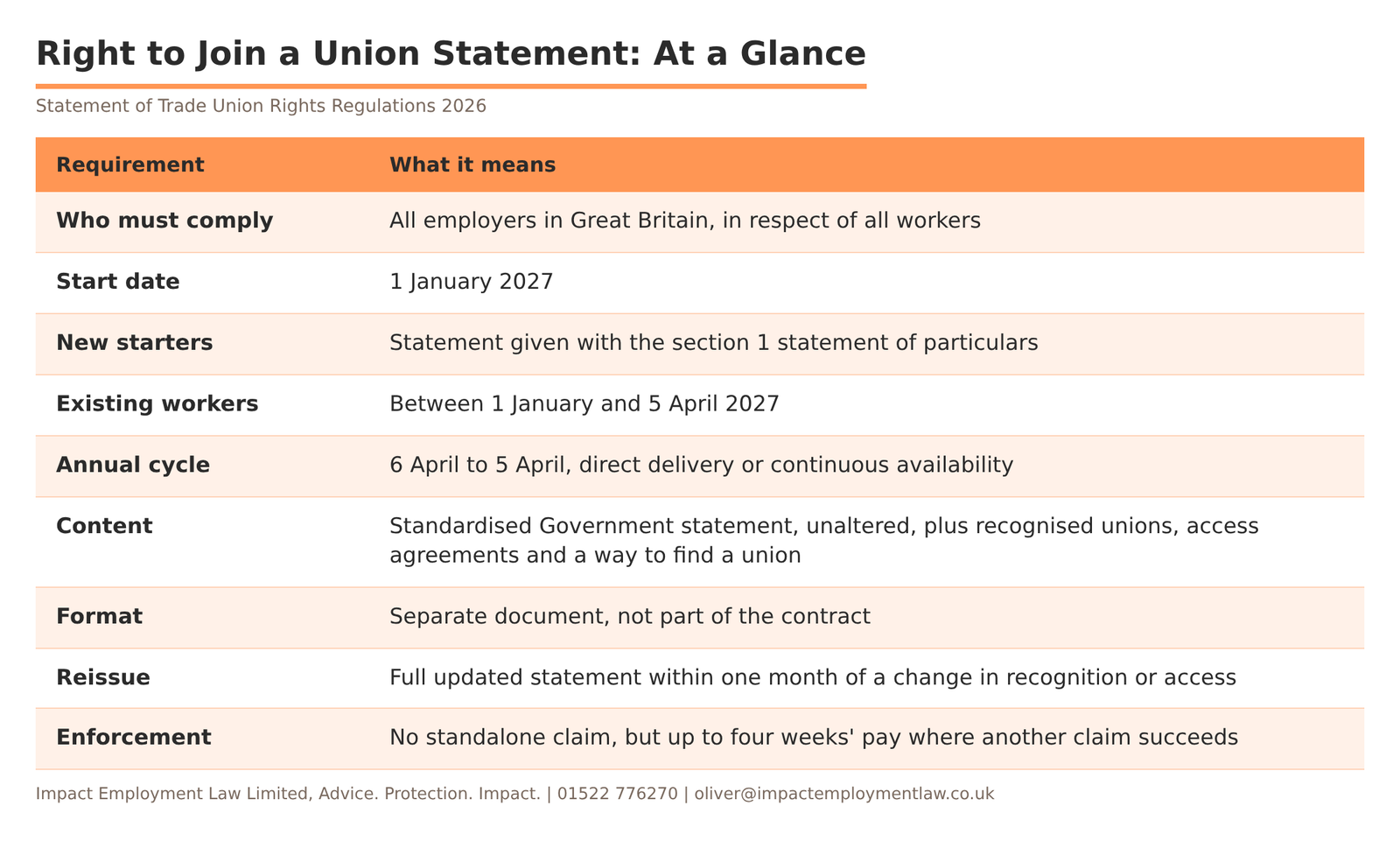
The detail we have been waiting for on the new duty to inform workers of their right to join a trade union has now been published. The Statement of Trade Union Rights Regulations 2026 and Government guidance confirm exactly what employers must do, and when. From 1 January 2027, employers in Great Britain must give workers (note not only employees) a standardised written statement of their right to join a union.
What the Duty Is
The duty sits in a new section 136A of the Trade Union and Labour Relations (Consolidation) Act 1992, inserted by the Employment Rights Act 2025. It applies to "workers", which is wider than employees and includes casual staff and others who are not employees.
Employers must use the standardised statement published by the Government. It explains the right to join a union, what unions do, what a recognised union is, what statutory access agreements are, how to find a union and workers' rights as members. Employers must not change it, except where the regulations require or permit additions. It also runs to four pages so it's not short and snappy.
What You Must Add
The statement is not entirely off the shelf. Employers must complete the workplace-specific sections:
Recognised unions: the name of every union recognised for collective bargaining across the organisation, even if it does not cover the person receiving the statement, with a summary of the worker groups and locations it covers and at least two general contact details. If there are none, the statement must say so.
Statutory access agreements: the same information for any union with a statutory access agreement, which links directly to the new right of access that took effect on 30 October 2026.
Finding a union: either a link to the Certification Officer's list of unions, or a copy of that list obtained no more than one calendar month before the statement is provided.
Contact details should not include individuals' names. Unions seeking recognition or access should not be listed until an arrangement is actually in place.
The Deadlines
New workers. Anyone who starts on or after 1 January 2027 must receive the statement at the same time as their section 1 written statement of employment particulars.
Existing workers. Those employed before 1 January 2027 and still employed on 5 April 2027 must be given the statement between 1 January and 5 April 2027.
Annual cycle. After that, the cycle runs from 6 April to 5 April each year. From 6 April 2027, employers choose each year whether to deliver the statement directly, or to keep it continuously available.
How to Provide It
There are two routes:
Direct delivery: electronically, by post or in person, as a separate document. It should not form part of the contract.
Continuous availability: the statement is kept somewhere accessible, such as an intranet, shared drive, website, noticeboard or handbook. Workers must be told in writing by 5 April where it is, under the heading "Availability and location of statement of trade union rights", and the notice must be factual and must not undermine the statement.
Methods can differ between groups of workers and can change from year to year, although switching method may require advance notice.
When You Must Reissue
If your recognition or access arrangements change, workers who have already received the statement must be given the full updated version within one calendar month. If the statement is continuously available in an unchanged location, a separate notice is not needed. A planned change of location needs at least one month's written notice to workers.
What Happens If You Get It Wrong?
There is no standalone claim for failing to provide the statement. A worker can raise the issue informally or through a grievance. However, if a worker succeeds in another claim, such as unauthorised deductions or unfair dismissal, a tribunal can award compensation of up to four weeks' pay for the failure, subject to the statutory weekly pay cap. With unfair dismissal rights arriving after six months from 1 January, that risk is not theoretical.
What Employers Should Do Now
Map your unions. Identify recognised unions and any statutory access agreements, and the groups and locations they cover.
Collect contact details. Ask each union for at least two general, non-personal contacts.
Update onboarding. New starters must receive the statement from 1 January.
Plan for existing staff. Decide how you will reach everyone by 5 April, including casual and agency-style workers.
Build a compliance calendar. Include the annual cycle and triggers for reissue.
Keep records. Note what was sent, to whom, when and how.
Impact
Impact Employment Law helps employers navigate the increased rights afforded to Trade Unions. We can help you prepare your statement and worker-specific sections, review your onboarding documents, plan how to reach existing staff, set up a compliance calendar and brief your managers. You should also be reviewing your contract of employment and policies in light of the other significant changes from the Employment Rights Act 2025.
We can also include it in a wider Employment Rights Act health check, alongside the union access rules and the changes arriving in January. Get in touch for a chat and we will make it simple.
Contact Oliver Tasker: 📞 Call: 01522 776270 ✉️ Email: oliver@impactemploymentlaw.co.uk
Advice. Protection. Impact.